TVS Apache RTR 310 Price, Top Speed, Height, Mileage & Features 2026
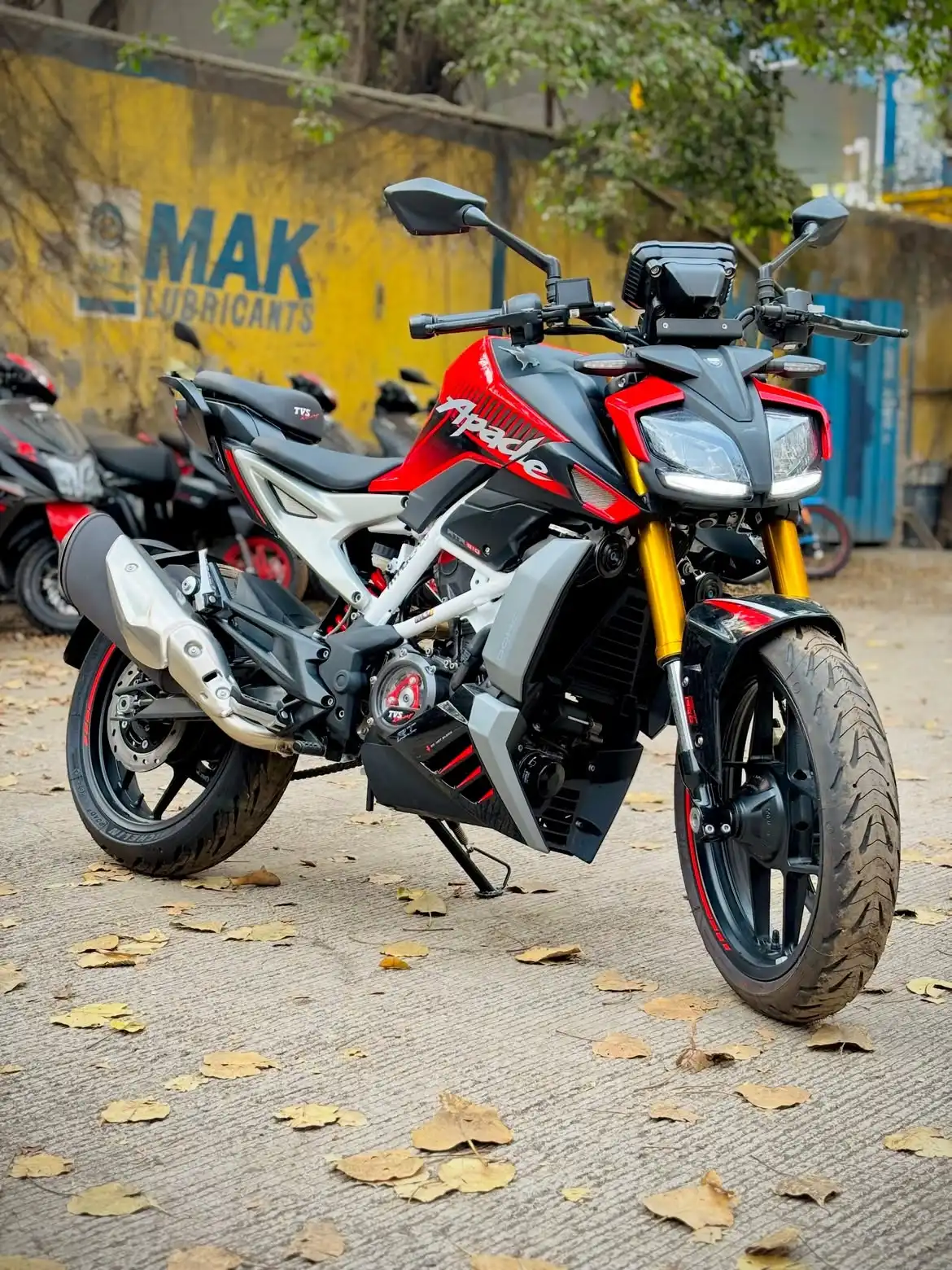
The TVS Apache RTR 310 is TVS's naked, streetfighter take on the Apache RR 310, and it remains one of the most talked-about performance motorcycles in India's 300cc space. In 2026, the TVS Apache RTR 310 price starts at roughly ₹2.25 lakh (ex-showroom) for the base trim and climbs to around ₹2.90 lakh for the fully loaded Anniversary Edition. It's powered by a 312.2cc, liquid-cooled engine that puts out close to 35.6 PS, and TVS claims a top speed of 150 km/h. With an approachable 800mm saddle height, this is a bike that's meant to feel usable in daily traffic and genuinely quick the moment the road opens up. Here's everything you need to know before you book one.
TVS Apache RTR 310 — At a Glance
*Bi-directional quickshifter is standard on most trims above the base "without quickshifter" variant. Figures are TVS's official claimed specifications for the India-spec model; actual on-road performance and mileage will vary. Price checked/updated: August 2026.
Table of Contents
TVS Apache RTR 310 Price 2026
The TVS Apache RTR 310 on-road price question is the one most buyers search for first, so let's settle it clearly. As of August 2026, the ex-showroom price of the Apache RTR 310 in India ranges from approximately ₹2.25 lakh for the entry Arsenal Black variant without a quickshifter, up to roughly ₹2.90 lakh for the top-spec Limited Anniversary Edition. TVS's own brand page for the motorcycle also lists a starting figure near ₹2.42 lakh for the standard naked-sport configuration, so the exact number you see can shift slightly depending on which colour and feature pack you pick.
The on-road price is a different figure altogether, and it is not something any brand can fix nationally. It's built from the ex-showroom price plus RTO road tax, registration charges, and a mandatory insurance premium — and every one of those varies by state and city. As a reference point only, the on-road price in Delhi has worked out to around ₹2.64 lakh for a mid-spec variant, but your own city's RTO and insurance slabs could push that number up or down. Always confirm the exact on-road figure with your nearest TVS dealership before booking.
Base Variant (Arsenal Black, no quickshifter)
Ex-showroom, India. Entry point into the RTR 310 line-up.
Top Variant (Limited Anniversary Edition)
Ex-showroom, India. Includes the full feature and styling package.
*Ex-showroom prices are indicative and sourced from TVS's official brand page and authorised dealer listings as of August 2026. Prices are revised periodically and can differ by city — always cross-check with your local TVS dealer before making a purchase decision.
TVS Apache RTR 310 Variants
The Apache RTR 310 is currently sold in seven variants, structured so riders can pick exactly how much performance hardware and styling they want to pay for:
- Arsenal Black Base (without Quickshifter) — the most affordable way into the RTR 310.
- Fury Yellow Base and Arsenal Black Base — standard trims with the quickshifter included.
- Fiery Red Base — same core spec, different colourway.
- BTO 1 (Dynamic Kit) — adds fully adjustable front and rear suspension, a tyre pressure monitoring system, and a brass-coated chain.
- BTO 2 (Dynamic Pro Kit) — layers in Race Tuned Dynamic Stability Control, cornering ABS, cornering traction control, wheelie control, launch control, drag torque control, and a keyless ride system.
- Limited Anniversary Edition — the flagship trim with unique Sepang Blue race livery and the most complete feature set.
TVS calls its higher trims "Built-To-Order" (BTO), which essentially means you're configuring the electronics and suspension package rather than choosing a completely different motorcycle underneath.
TVS Apache RTR 310 Colours
The Apache RTR 310 is available in a set of colour options that lean into its streetfighter identity rather than the more conservative shades typical of commuter bikes:
- Arsenal Black
- Fiery Red
- Fury Yellow
- Sepang Blue (TVS Racing-inspired livery, offered on select trims)
- Black and Champagne Gold (select markets/trims)
Design & Build Quality
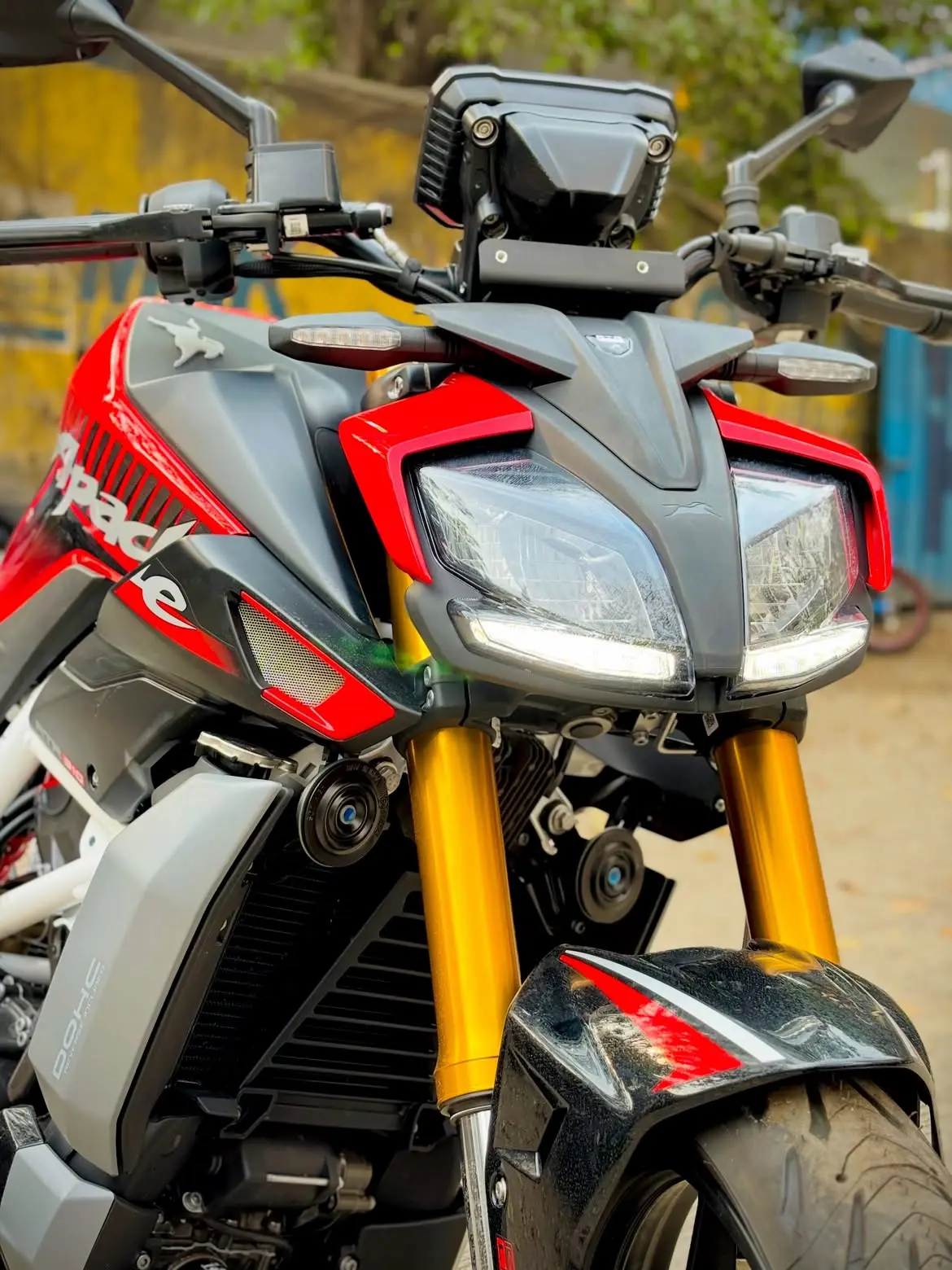
TVS designed the RTR 310 around what it calls "streetfighter styling" — sharp, angular surfacing over a compact, forward-biased stance. The split-type headlamp uses adaptive Bi-LED elements with sequential turn signal lamps, which is genuinely useful after dark rather than being a purely cosmetic addition. A transparent, anti-fog clutch cover shows off the internals, sculpted knuckle guards break up the wind at speed, and the tail is raked upward to keep the rear end visually light.
Build quality feels a notch above what TVS offered on earlier Apache RTR models. Panel gaps are tight, the switchgear has a solid click to it, and the fit of components like the tank shrouds and belly pan doesn't show the flex you sometimes find in this price bracket. The Hyper-Spec trellis frame, paired with a lightweight aluminium sub-frame, is shared with the RR 310, which is part of why the RTR 310 handles the way it does — more on that in the ride quality section below.
Engine & Performance
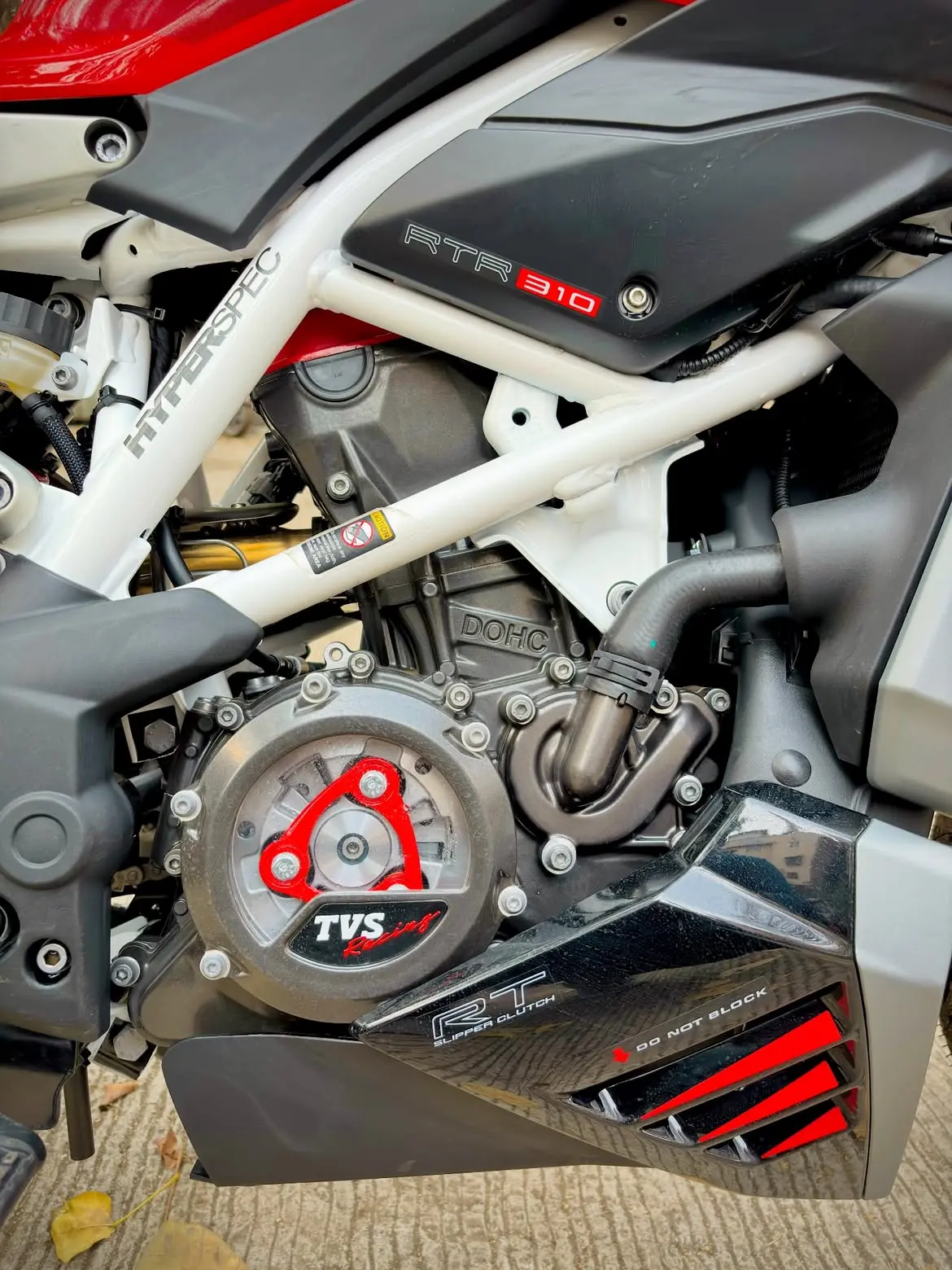
At the core of the RTR 310 is a 312.2cc, single-cylinder, liquid-cooled engine with a reverse-inclined DOHC layout — a genuinely unusual architecture at this price point, borrowed directly from the RR 310. TVS says the forged aluminium pistons are around 5% lighter than a conventional design, which helps the engine rev more freely and improves the power-to-weight ratio. Official figures put peak power at 35.6 PS at 9,700 rpm and peak torque at 28.7 Nm at 6,650 rpm.
Editorial interpretation: On paper, those numbers put the RTR 310 firmly ahead of most 160–200cc naked bikes and squarely into KTM 250 Duke and Bajaj Dominar 400 territory. In practical daily use, this translates to strong roll-on acceleration in city traffic without constant gear changes, and a genuinely quick, linear pull once you're past 6,000rpm on the open road. TVS's official performance claims put the 0–60 km/h sprint at 2.81 seconds and 0–100 km/h at 7.1 seconds — quick enough that overtaking on two-lane highways rarely requires dropping more than one gear.
TVS Apache RTR 310 Top Speed
TVS's officially claimed maximum speed for the Apache RTR 310 is 150 km/h. This is a manufacturer-stated figure, not an independently verified real-world test result, so treat it as the bike's engineered ceiling under ideal conditions rather than a number you'll consistently see on an everyday ride.
What matters more for most riders is how the bike behaves well before that limit. In Rain mode, TVS caps output at 120 km/h for safety, while Sport and Track modes unlock the engine's full performance envelope. Real-world highway cruising in the 90–110 km/h range feels comfortable and stable, thanks largely to the rigid trellis frame and the KYB suspension working in tandem to keep the front end planted.
Mileage
TVS's ARAI-claimed mileage figures for the Apache RTR 310 are 30 km/l in Urban and Rain modes, and 28 km/l in Sport, Track, and Supermoto modes. These are certified test-cycle numbers, and like any ARAI figure, they represent a best-case scenario measured under controlled conditions.
Actual, real-world fuel efficiency will vary depending on your riding style, how much time you spend in traffic versus open roads, which ride mode you use most, road conditions, how much load the bike is carrying, and how regularly it's serviced. Riders who keep the bike in Urban mode for daily commuting and maintain steady throttle inputs typically report figures closer to the ARAI number, while frequent hard acceleration in Sport or Track mode will bring that down noticeably. We're not going to promise a fixed real-world number here — it genuinely depends on how you ride it.
Gearbox & Quickshifter
The RTR 310 uses a 6-speed gearbox with a race-derived shift mechanism — a bottom-mounted shift lever and a negative back-rack angle machined into the gears for quicker, more positive engagement. Most variants above the base trim get a bi-directional quickshifter, letting you clutch-less upshift and downshift, which genuinely speeds up gear changes and adds a bit of that "bigger bike" feel to spirited riding.
A wet, multi-plate slipper-and-assist clutch rounds out the package — it reduces lever effort for everyday use while preventing rear-wheel hop during aggressive downshifts, so you can brake later into corners with more confidence.
Ride Modes
The Apache RTR 310 offers five ride modes, each recalibrating throttle response, ABS behaviour, and power delivery:
- Urban — quick, punchy acceleration tuned for city traffic, with responsive dual-channel ABS.
- Rain — power capped near 120 km/h, linear throttle mapping, and stronger ABS intervention with rear-lift protection to reduce aquaplaning risk.
- Sport — maximum acceleration across the rev range with race-mapped fuel injection and smoother engine braking on deceleration.
- Track — full access to the engine's output with minimal ABS interference, meant for closed circuits.
- Supermoto — disengages rear ABS while keeping peak power, aimed at controlled slides rather than public road use.
Suspension & Ride Quality
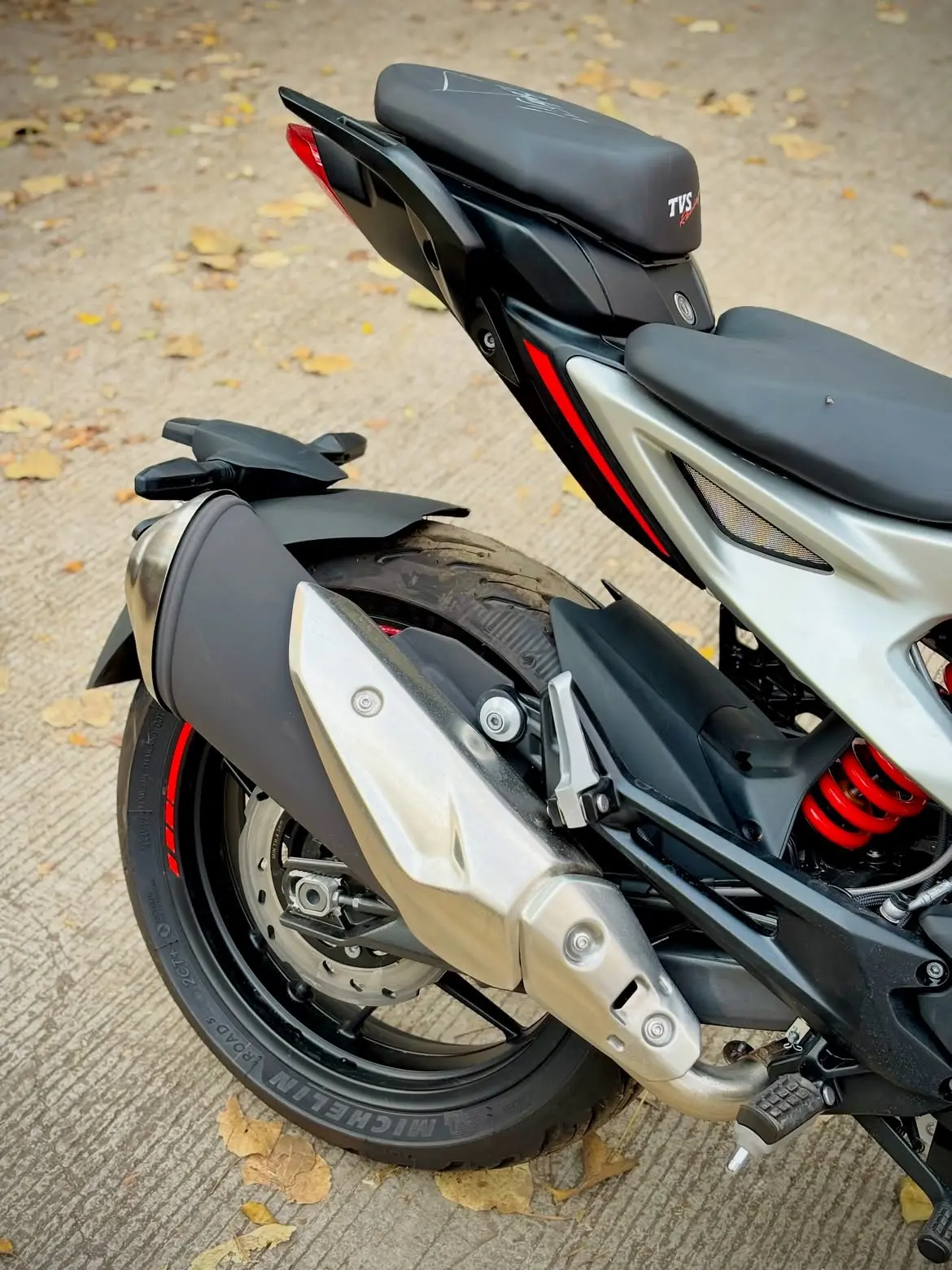
Up front, the RTR 310 runs a 43mm USD (upside-down) fork, while the rear uses a KYB-tuned monoshock with monotube floating-piston technology, offering preload adjustment as standard and full adjustability (preload, compression, and rebound) on the higher BTO Dynamic Kit trims. TVS positions this setup for "best-in-class lateral acceleration and cornering performance," and in practice the chassis does feel composed when leaned into a corner, without the vagueness some budget naked bikes show at higher lean angles.
Editorial interpretation: Day-to-day ride quality leans firm rather than plush — this is a bike tuned with performance riding as the priority, so expect a bit more feedback from broken city roads than you'd get on a pure commuter. It's not harsh, but riders coming from a soft-riding scooter or commuter motorcycle will notice the difference in the first week.
Braking & ABS
Both front and rear brakes are disc units, backed by dual-channel ABS as standard across the range. Move up to the BTO Dynamic Pro Kit trim and you gain cornering ABS, which continues to modulate braking force even while the bike is leaned over — a genuinely useful safety net if you brake mid-corner in an emergency. The same higher trim also adds Race Tuned Dynamic Stability Control, using a 6-axis inertial measurement unit (IMU) to help manage braking and power delivery during critical low-side situations.
Tyres & Wheels
The RTR 310 rolls on 17-inch alloy wheels shod with tubeless tyres — a 110/70 section at the front and a wider 150/60 at the rear, mounted on a solid die-cast aluminium swingarm. This is a fairly standard setup for the segment, prioritising predictable handling over the sportier, wider rubber you'd find on something like the fully-faired RR 310.
Features & Technology
This is where the RTR 310 punches well above its price bracket. Key features, depending on variant, include:
- Bi-directional quickshifter — clutch-less up and down shifts.
- Cruise control — holds a steady speed on highways without constant throttle input.
- Linear traction control — a segment-first system that manages torque delivery to prevent rear-wheel spin on slippery surfaces.
- Cornering ABS & cornering traction control (higher trims) — braking and traction management that continues to work mid-lean.
- Glide Through Technology (GTT) — lets you move off from a stop by releasing the clutch alone, without needing to coordinate throttle input, which is genuinely helpful in stop-go traffic.
- Tyre Pressure Monitoring System (TPMS) (BTO trims) — live front and rear tyre pressure readouts with alerts.
- Keyless ride system (BTO trims) — start the bike and lock or unlock the handlebar electronically once the key fob is detected nearby.
- Launch control and wheelie control (BTO Dynamic Pro Kit) — race-style assists for standing starts and controlled acceleration.
TFT Display & SmartXonnect
The RTR 310 is built around a 5-inch horizontal TFT "race computer" that doubles as the control hub for the bike's electronics — you can adjust traction control settings, cruise control, headlamp brightness, and manage Bluetooth-paired music from here. Paired with the TVS SmartXonnect app, it adds post-ride telemetry (gear-shift points, lean angle data, ride-pattern analysis), voice assist for select cluster functions, What3Words-based navigation, call and SMS handling, GoPro camera control, and an automatic crash-alert system that notifies emergency contacts with your location if the bike detects a fall.
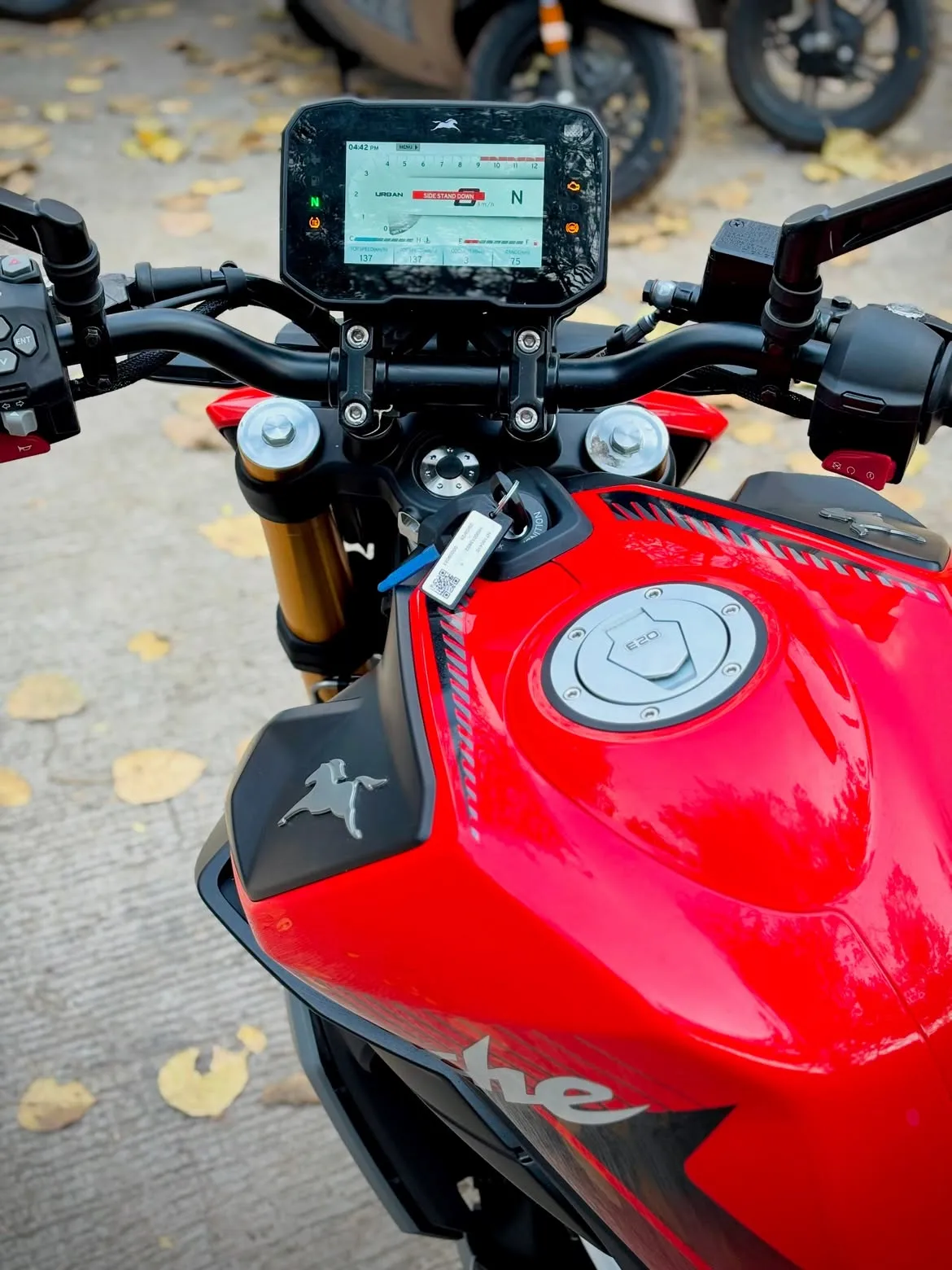
Dimensions & Height
What is the height of the TVS Apache RTR 310? There are actually two different height figures people mean when they ask this, and they matter for different reasons.
- Overall bike height: 1,154 mm, measured from the ground to the highest fixed point of the motorcycle (typically the handlebar or headlamp cowl).
- Saddle (seat) height: 800 mm, measured from the ground to the top of the seat.
- Ground clearance: 180 mm.
For almost every rider trying to judge whether they'll be comfortable on this bike, saddle height is the number that actually matters. Overall height tells you almost nothing about reach to the ground or riding posture — it's influenced by the handlebar and headlamp position, not where you sit. At 800mm, the RTR 310's seat height is genuinely approachable; most riders around 5'4" and taller should be able to get a confident flat-footed or near-flat-footed stance at a standstill, which matters a lot in slow-moving city traffic and while parking.
Weight & Ground Clearance
The TVS Apache RTR 310 weight comes in at 169 kg (kerb weight), which includes fuel, oil, and all standard fluids ready to ride. That's a genuinely competitive figure for a 300cc-class motorcycle with this much hardware on board — it's roughly 5kg lighter than its fully-faired sibling, the RR 310, largely because the RTR skips the full fairing panels. Ground clearance of 180mm is comfortable for Indian road conditions, including moderately broken surfaces, speed breakers, and light off-tarmac sections without scraping the belly pan.
Fuel Tank Capacity
The Apache RTR 310 carries an 11-litre fuel tank. Combined with its ARAI-claimed mileage figures, that works out to a theoretical range of roughly 300–330 km per tank under ideal conditions — enough for most riders to comfortably plan a full day's ride, including a reasonable weekend touring stint, without constantly hunting for fuel stations.
Maintenance & Ownership
As a liquid-cooled, DOHC performance engine, the RTR 310 sits a step above simpler air-cooled commuter motorcycles in terms of mechanical complexity, and running costs typically reflect that. Expect service intervals and costs broadly in line with other premium 300cc naked bikes in India — higher than a 150cc commuter, but generally more affordable than fully imported rivals like the KTM 390 Duke or Kawasaki Ninja 300, since TVS builds and services the RTR 310 through its existing dealer network with reasonably wide part availability.
Because this is a performance-oriented engine that spends time at higher revs, sticking to the recommended service schedule and using the correct grade of engine oil matters more here than it would on a low-stress commuter engine.
Warranty
TVS typically covers its premium Apache range with a standard warranty period, and often offers optional extended warranty packages through authorised dealerships for buyers who want longer coverage. Exact warranty terms, extended plans, and any ongoing promotional coverage can change, so confirm the current warranty and extended-warranty options directly with your TVS dealer at the time of purchase — this is the kind of detail worth getting in writing on your booking form.
Pros & Cons
What Works Well
- Strong power-to-weight ratio for the segment and price
- Genuinely approachable 800mm seat height
- Feature list (quickshifter, cruise control, traction control, TFT) rarely matched at this price
- Trellis frame and KYB suspension deliver confident handling
- Wide network of TVS dealers for sales and service across India
Where It Falls Short
- Suspension is tuned firm — not the most plush ride on badly broken roads
- Real-world mileage in Sport/Track mode drops noticeably below the ARAI figure
- Top-spec BTO trims push the price close to ₹2.9 lakh, where direct rivals from other brands enter the conversation
- Pillion comfort is adequate rather than outstanding on longer rides
TVS Apache RTR 310 vs Competitors
The RTR 310 competes in a crowded 250–400cc naked motorcycle segment. Its closest rivals by price, engine class, and buyer intent include the KTM 250 Duke, Bajaj Dominar 400, and its own sibling, the fully-faired Apache RR 310.
| Motorcycle | Ex-Showroom Price | Engine | Power | Kerb Weight |
|---|---|---|---|---|
| TVS Apache RTR 310 | ₹2.25 – 2.90 Lakh | 312.2cc, liquid-cooled | 35.6 PS | 169 kg |
| KTM 250 Duke | ≈ ₹2.27 Lakh | 249cc, liquid-cooled | ~30 PS | ~163 kg |
| Bajaj Dominar 400 | ≈ ₹2.30 – 2.55 Lakh | 373cc, liquid-cooled | ~40 PS | ~193 kg |
| TVS Apache RR 310 | ₹2.62 – 3.15 Lakh | 312.2cc, liquid-cooled | ~35–38 PS | 174 kg |
Where the RTR 310 is stronger: feature-per-rupee value, an approachable seat height, and a genuinely engaging chassis for its weight class. Where rivals may be better: the Dominar 400 offers more outright torque and a more relaxed touring stance for highway-heavy riders, while the KTM 250 Duke has a slightly punchier low-end feel in pure city commuting. We wouldn't call the RTR 310 the outright "best" in every scenario — it depends heavily on whether you prioritise features, torque, or outright touring comfort.
TVS Apache RTR 310 vs Apache RR 310
This is one of the most common internal comparisons TVS buyers make, since both bikes share the same core platform. Here's how they actually differ where it counts:
TVS Apache RTR 310
- Naked streetfighter styling, no fairing
- Upright, wider handlebar riding position — more relaxed for city and daily commuting
- 169 kg kerb weight, 800mm seat height
- Starts around ₹2.25 lakh, ex-showroom
- Slightly less wind protection at highway speeds
- Better suited to riders who want an everyday bike with weekend performance
TVS Apache RR 310
- Fully-faired sportbike styling
- Lower clip-on handlebars, more committed, track-oriented riding position
- 174 kg kerb weight, 810mm seat height
- Starts around ₹2.62 lakh, ex-showroom
- Better aerodynamics and wind protection on the highway
- Better suited to riders who want a track-day capable sportbike as their primary machine
In short: same engine DNA, different intent. If you spend most of your time in city traffic with occasional highway runs and want a more relaxed seating posture, the RTR 310 is the more practical daily choice. If your priority is outright sportbike character, aerodynamics, and you don't mind a more committed riding position, the RR 310 justifies its higher price.
Buying Guide
Who Should Buy the TVS Apache RTR 310?
This bike makes the most sense for riders upgrading from a 150–200cc commuter or naked bike who want a meaningful jump in performance and tech without moving into fully-faired sportbike territory. It also suits riders who want a daily commuter that can genuinely deliver a spirited weekend ride — the wide feature set (cruise control, traction control, ride modes) makes it feel more premium than its price tag suggests.
Who Should Avoid It?
If your primary need is long-distance touring comfort with a relaxed riding triangle and strong wind protection, a dedicated tourer will likely serve you better. Riders who prioritise plush comfort over sharp handling, or who need significantly higher ground clearance for regular off-road use, should also look elsewhere — this is fundamentally a road-focused streetfighter, not an adventure bike.
Is the Price Justified?
Given the electronics package, engine architecture, and build quality on offer, the RTR 310's pricing is competitive against both Indian and imported rivals in this bracket. The value proposition strengthens the further up the variant ladder you go, since features like cornering ABS and traction control are rarely available at this price point from other manufacturers.
Final Verdict
The TVS Apache RTR 310 earns its place in the 300cc naked bike conversation on the strength of three things: a genuinely capable engine for the price, an approachable seat height that doesn't punish shorter riders, and a features list that undercuts rivals costing significantly more. Its biggest strength is how much performance hardware and electronics TVS has packed into a sub-₹3-lakh motorcycle. Its biggest weakness is a suspension tune that prioritises sharp handling over plush comfort, which some riders on rough city roads may find firmer than expected.
Against the RR 310, the RTR 310 is the more practical everyday choice for most buyers, while the RR 310 remains the pick for riders who specifically want a fully-faired sportbike riding position. Overall, if you're shopping in the 250–350cc naked motorcycle segment and want strong value on features without stepping up to a KTM Duke or Dominar 400's price and weight, the Apache RTR 310 deserves a serious test ride.
Full Specification Table
| Engine type | Single-cylinder, 4-stroke, reverse-inclined DOHC, liquid-cooled |
| Engine capacity | 312.2 cc |
| Maximum power | 35.6 PS @ 9,700 rpm |
| Maximum torque | 28.7 Nm @ 6,650 rpm |
| Bore x Stroke | Officially not disclosed |
| Compression ratio | Officially not disclosed |
| Fuel injection | Ride-by-wire, throttle-by-wire |
| Cooling | Liquid-cooled with oil-coolant technology, 23-row radiator |
| Clutch | Wet, multi-plate slipper & assist clutch |
| Gearbox | 6-speed, bi-directional quickshifter (select variants) |
| Claimed top speed | 150 km/h |
| 0–60 km/h | 2.81 seconds (claimed) |
| 0–100 km/h | 7.1 seconds (claimed) |
| Frame | Hyper-Spec trellis frame with aluminium sub-frame |
| Front suspension | 43mm USD fork (fully adjustable on BTO Dynamic Kit) |
| Rear suspension | KYB monoshock, preload adjustable (fully adjustable on higher trims) |
| Front brake | Disc |
| Rear brake | Disc |
| ABS | Dual-channel; cornering ABS on BTO Dynamic Pro Kit |
| Front tyre | 110/70 R17, tubeless |
| Rear tyre | 150/60 R17, tubeless |
| Wheelbase | 1,358 mm |
| Ground clearance | 180 mm |
| Overall height | 1,154 mm |
| Overall length | 1,991 mm |
| Overall width | 831 mm |
| Saddle height | 800 mm |
| Kerb weight | 169 kg |
| Fuel tank | 11 litres |
| Battery | Officially not disclosed |
| Headlamp | Adaptive Bi-LED Cyborg headlamp with sequential TSL |
| Tail lamp | LED |
| Instrument cluster | 5-inch horizontal TFT with SmartXonnect connectivity |
Frequently Asked Questions
What is the TVS Apache RTR 310 price in India?
As of August 2026, the TVS Apache RTR 310 ex-showroom price ranges from approximately ₹2.25 lakh for the base variant to around ₹2.90 lakh for the top Limited Anniversary Edition. On-road price varies by city, based on RTO tax, registration, and insurance charges — check with your local TVS dealer for the exact figure.
What is the TVS Apache RTR 310 top speed?
TVS's officially claimed maximum speed for the Apache RTR 310 is 150 km/h. This is a manufacturer-stated figure under ideal test conditions, not an independently verified real-world result.
What is the TVS Apache RTR 310 height?
The overall bike height is 1,154 mm. The seat (saddle) height, which is what matters most for reach and riding posture, is 800 mm. Ground clearance is 180 mm.
What is the TVS Apache RTR 310 seat height?
The saddle height is 800 mm, which is considered approachable for most riders and makes the bike manageable in stop-and-go city traffic.
What is the mileage of the TVS Apache RTR 310?
TVS's ARAI-claimed mileage is 30 km/l in Urban and Rain ride modes, and 28 km/l in Sport, Track, and Supermoto modes. Real-world mileage will vary with riding style, traffic, ride mode used, road conditions, and maintenance.
What is the engine capacity of the TVS Apache RTR 310?
The RTR 310 uses a 312.2cc, single-cylinder, liquid-cooled engine with a reverse-inclined DOHC layout.
How much power does the RTR 310 produce?
TVS officially claims 35.6 PS at 9,700 rpm and 28.7 Nm of torque at 6,650 rpm.
What is the weight of the RTR 310?
The kerb weight of the TVS Apache RTR 310 is 169 kg, ready to ride with fuel and fluids.
Does the RTR 310 have a quickshifter?
Yes, most variants above the entry "without quickshifter" trim come with a bi-directional quickshifter for clutch-less up and down gear changes.
Does the RTR 310 have traction control?
Yes. It features linear traction control as standard on most trims, with cornering traction control and wheelie control added on the higher BTO Dynamic Pro Kit variant.
RTR 310 vs RR 310, which one should you choose?
The RTR 310 suits riders who want a more upright, relaxed daily-commuting posture with weekend performance, and it costs less to start. The RR 310 suits riders who specifically want a fully-faired sportbike riding position and don't mind paying more for it. Both share the same core engine and chassis DNA.
Are these answers based on official and current information?
Yes. Specifications, features, and performance figures in this article are sourced from TVS Motor's official Apache RTR 310 brand page and cross-checked against current authorised listings as of August 2026. Price figures are indicative and should always be reconfirmed with your local TVS dealer, since ex-showroom and on-road prices are revised periodically and differ by city.
Related Articles
RiderRaj may earn a commission on qualifying purchases made through affiliate links on this page, at no extra cost to you. This does not influence our editorial coverage or ratings.