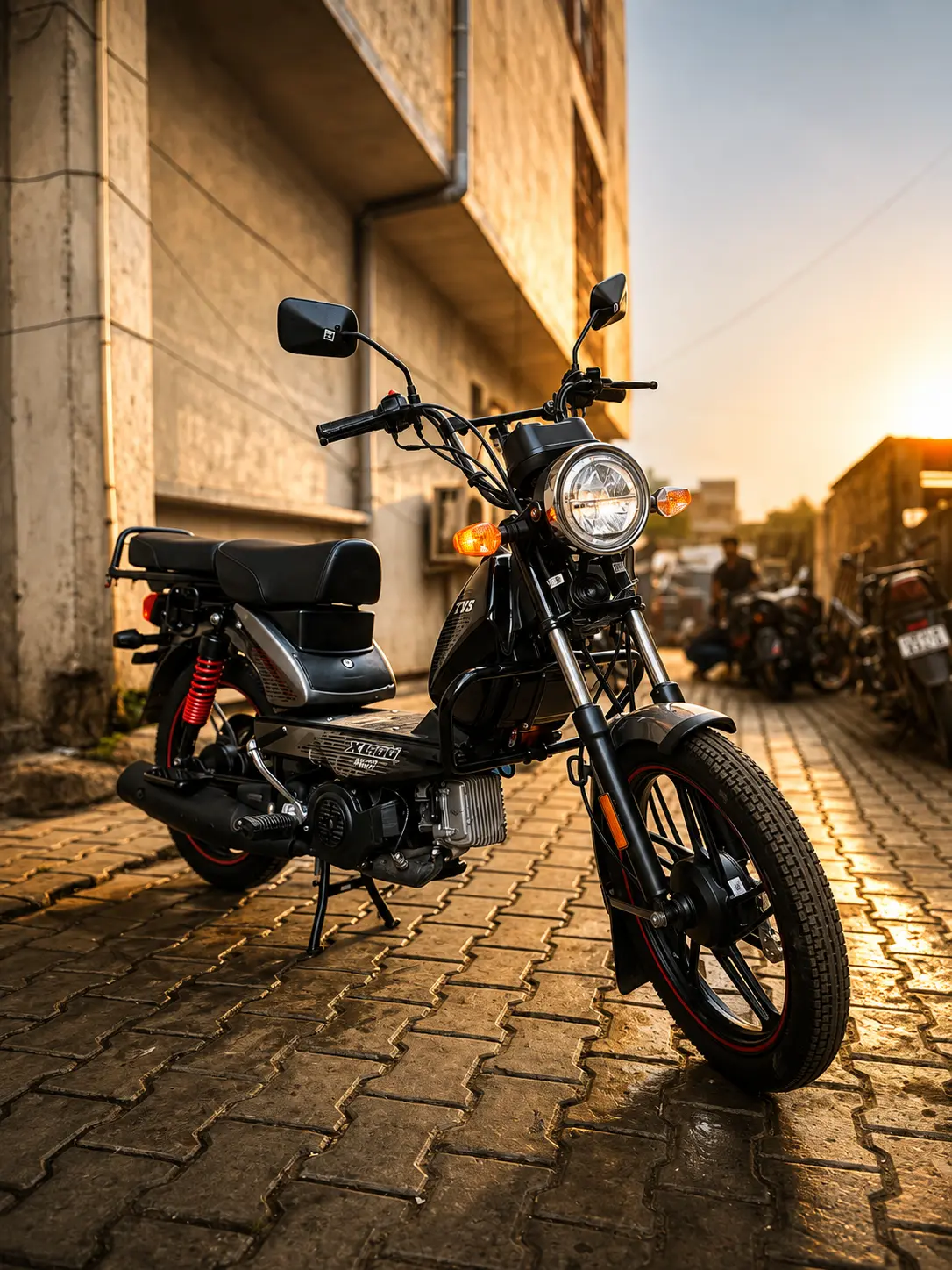
TVS XL100 Heavy Duty Alloy 2026: The Moped That Was Built to Never Say No to a Load
If your day includes milk cans, sabzi crates, school bags and a pillion — in that order, before 9 AM — this review tells you exactly whether the new alloy-wheel XL100 earns its ₹61,860 price tag, or whether you should save the difference.
Who Should Actually Buy the TVS XL100 HD Alloy?
The TVS XL100 Heavy Duty Alloy is for anyone who needs a two-wheeler that works harder than they do — shop owners doing daily pickups, milk and newspaper delivery riders, farmers moving between field and mandi, and families in small towns who need one vehicle to do five different jobs. It is not built to impress your college friends at a signal. It is built to start every single morning, carry more than it should, and not complain about it for the next ten years.
We spent time going through the official TVS specification sheet, the brochure, real ownership feedback from users, and rode through the kind of roads this bike is actually sold for — broken village lanes, market traffic, and the odd highway stretch — before writing this. Here is the honest version, not the brochure version.
New 16-inch alloy wheels with tubeless tyres, an LED headlamp, and a claimed mileage boost make this the most complete XL100 variant — but at ₹61,860, it also sits close to bikes with a gear, a clutch and more highway comfort. Read on before you decide.
What's New in the TVS XL100 HD Alloy 2026
The XL100 nameplate has been around for decades as India's go-to "load carrier on two wheels." The Heavy Duty Alloy trim is TVS's way of giving this legacy moped a more modern face without touching the one thing that made it famous — its ability to survive anything.
- 16-inch alloy wheels replace the older spoke wheel setup on this top trim, adding road presence and reducing the periodic spoke-tightening that spoke-wheel owners are used to.
- Tubeless tyres on both ends — a genuinely useful upgrade for anyone who has ever pushed a tubed-tyre moped to a puncture shop in the middle of nowhere.
- New LED headlamp with Automatic Headlamp On (AHO), replacing the halogen unit used on older, more basic XL100 trims.
- ETFi (EcoThrust Fuel Injection) technology, which TVS says is tuned to deliver better startability, smoother throttle response, and improved mileage over the old carbureted engine.
- Fresh graphics and an all-black muffler that give the bike a slightly more grown-up, less "utility-only" look on the outside.
None of this changes the fundamental character of the XL100. It is still a gearless, no-clutch, twist-and-go moped built around simplicity. The 2026 changes are about polishing that formula, not reinventing it.
Design, Build Quality & Paint Quality
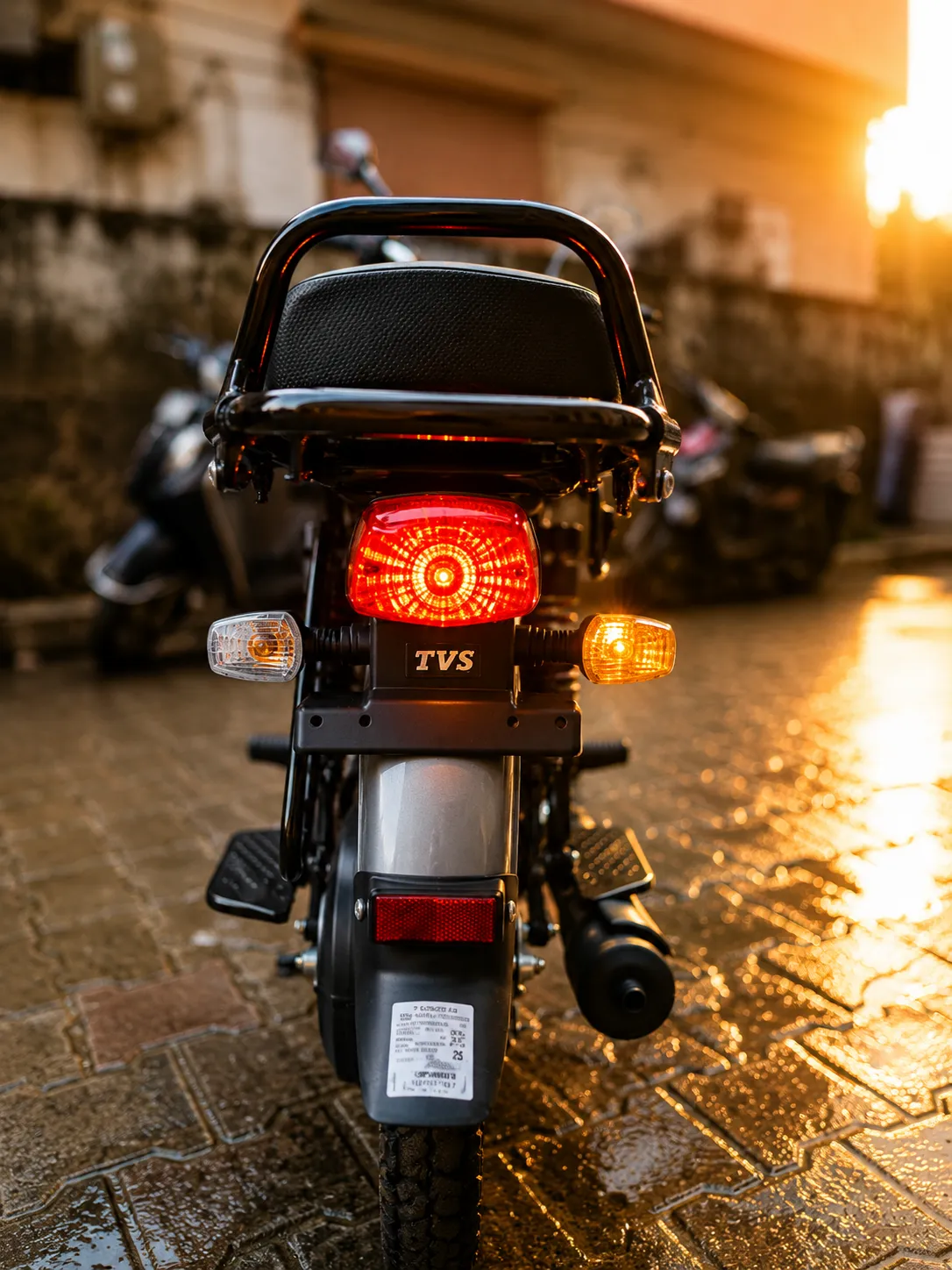
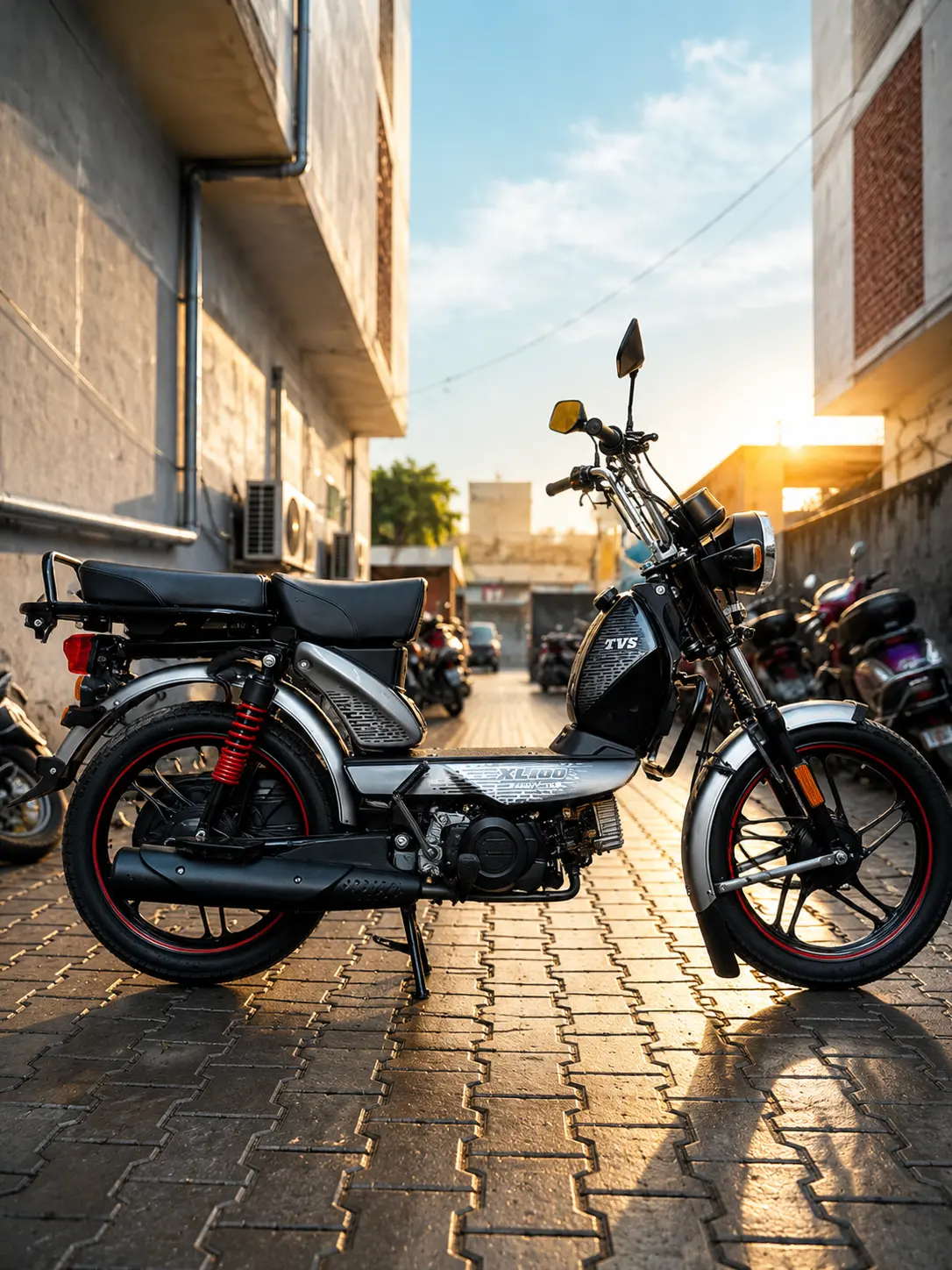
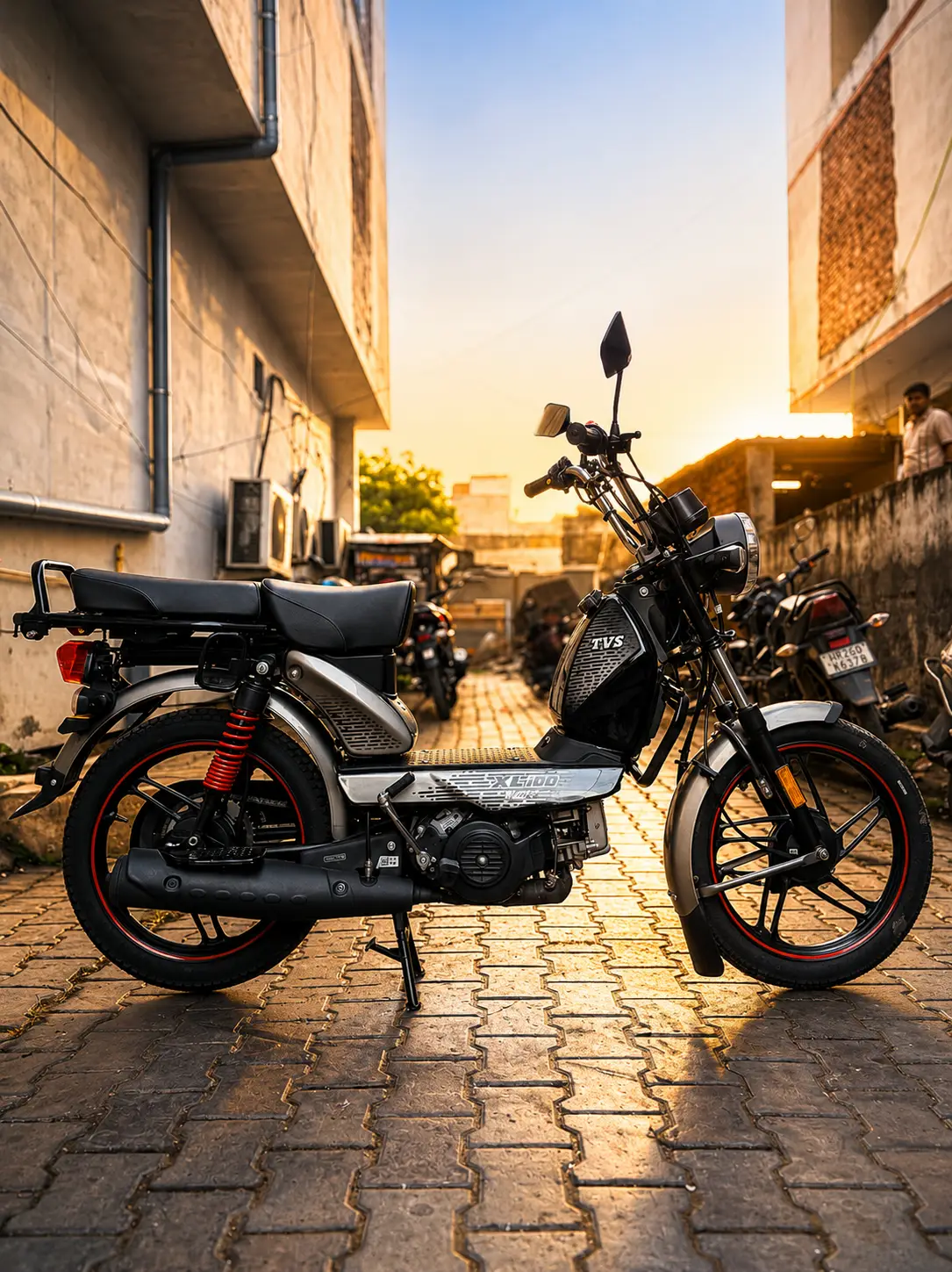
The XL100 has never tried to look like a motorcycle, and the HD Alloy doesn't pretend either. It has an upright, boxy stance with a flat, wide floorboard and a step-through frame that makes it easy to mount even with a full load hanging off the back. The new alloy wheels are the biggest visual change — they instantly make the bike look less "basic moped" and more like a proper commuter.
 Tap to zoom
Build quality on the XL100 has always been one of its strongest points, and that continues here. TVS describes the body as an all-metal construction, and in daily use this translates to a bike that shrugs off the small knocks, scrapes and overloading that would rattle a plastic-heavy scooter. The paint on the metal panels holds up reasonably well to sun and rain, though like any budget commuter, the underside and exhaust area will need a wash-down after monsoon rides through slush.
Shop owners who use the XL100 for daily goods transport often report the metal body panels handling rope-tied loads and crate corners far better than a scooter's plastic panels would.
Seat Comfort & Ride Quality
TVS fits the HD Alloy with what it calls a hi-grip, textured seat, and in practice it does its job — the texture stops you from sliding forward under braking, which matters when you're riding with a pillion or extra cargo. The seat is also detachable, which is a small but genuinely useful feature for owners who need to strap on extra luggage using the underlying frame.
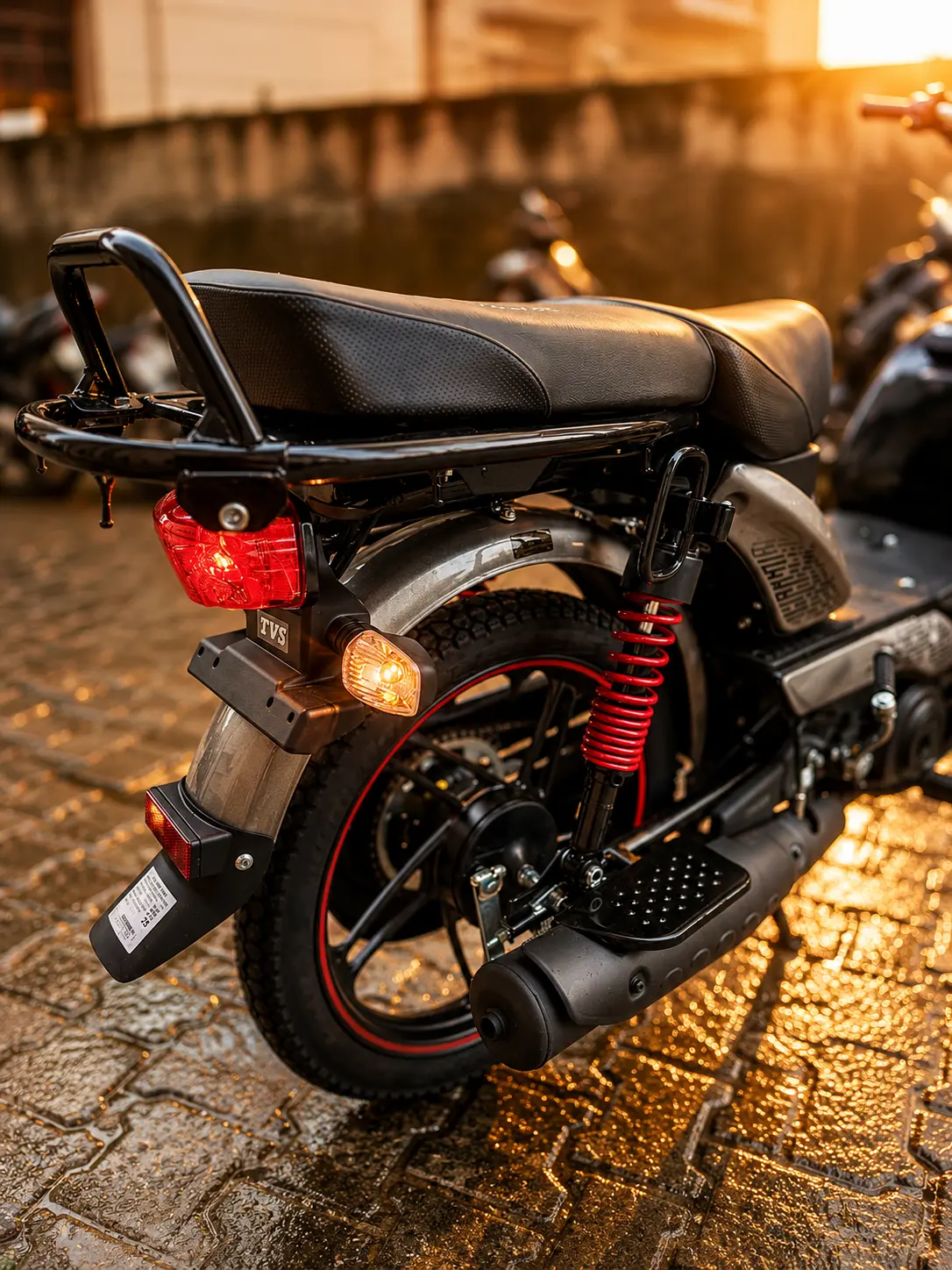
Ride quality leans towards "practical" rather than "plush." The front gets a telescopic spring-type suspension with damping, and the rear uses a swingarm with hydraulic shock absorbers. Over broken tar and small potholes, this setup does a fair job of taking the edge off. Over deep potholes or unpaved village stretches at speed, you will feel it in your spine — this is a budget moped's suspension, not a premium commuter's.
What Feels Good
- Upright seating posture is easy on the back during short, frequent stops (deliveries, shop runs).
- Low seat height and light kerb weight make it easy for shorter riders to manage in traffic.
Where It Struggles
- Long, continuous highway stretches get tiring due to the compact seat and upright posture.
- Suspension travel is limited, so sharp potholes are felt more than absorbed.
Engine, Performance & Real-World Mileage
The XL100 HD Alloy runs a 99.7cc, single-cylinder, air-cooled, 4-stroke engine with EcoThrust Fuel Injection (ETFi), officially producing 3.20 kW (4.35 PS) at 6,000 rpm and 6.5 Nm of torque at 3,500 rpm. Power goes through a centrifugal wet clutch and a single-speed gearbox to a chain-and-sprocket final drive — in plain language, there is no gear lever and no clutch lever to operate. You twist the throttle, and it goes. This is exactly why the XL100 remains a favourite with first-time riders, older family members, and anyone who wants zero learning curve.
Real-World Mileage: What Owners Actually Report
TVS's official brochure page does not publish a certified ARAI mileage figure for the HD Alloy variant, so we won't invent one. What we can tell you, based on third-party tracking platforms and user-reported figures, is that owners commonly report real-world mileage in the 55 to 67 kmpl range, depending on load, traffic, and how gently the throttle is used. TVS's own marketing for the ETFi engine claims roughly 15% better mileage over the outgoing carbureted version, though this is a company claim and not an independently verified test figure.
Mileage claims on any commuter vehicle vary heavily with rider weight, load, tyre pressure and traffic. Treat 55–67 kmpl as a realistic field range, not a promise. If mileage is your single biggest priority, ask your local dealer for a short test ride under your actual daily conditions before booking.
Top Speed & Acceleration
TVS officially rates the maximum speed of the XL100 HD Alloy at 58 km/h. This is not a bike built for overtaking on a highway — it's built to cruise comfortably between 40-50 km/h, which is where most Indian city and village riding actually happens anyway. Acceleration off the line is adequate for a 99.7cc engine carrying one rider; with a pillion and cargo, expect a noticeably slower build-up of speed, which is normal for this segment.
“This vehicle is very useful for heavy loading purposes. It has a large loading area at both the front and back, making it highly practical. Handling is easy and comfortable for daily business use. — XL100 owner review, shared on a public bike-price platform
City, Village, Highway & Heavy-Load Riding
A commuter bike's real report card is written on the roads it's actually used on — not a test track. Here's how the XL100 HD Alloy behaves across the kind of riding its buyers actually do.
🏙️ City Riding
Light kerb weight (89 kg) and a tight turning radius make this an easy bike to filter through traffic and park in tight lanes. The gearless twist-and-go setup means no clutch fatigue at signals.
🌾 Village & Rural Roads
This is where the XL100 was born to work. The 150 mm ground clearance handles uneven mud and gravel paths reasonably well, and the tubeless tyres on the new alloy wheels reduce the chance of a flat on stone-strewn tracks.
🛣️ Highway Stretches
Not the bike's strong point. With a 58 km/h top speed, it will feel underpowered on open highways where cars and bigger bikes move faster. It's built for stop-start commuting, not long-distance touring.
📦 Heavy Load Riding
TVS rates payload at 150 kg on top of the bike's own 89 kg kerb weight — genuinely useful for milk cans, vegetable crates, or a pillion plus shopping. Expect softer acceleration and a firmer-feeling ride when loaded close to the limit.
Owners who use the XL100 for daily commercial work — milk delivery, small shop supply runs, farm-to-market trips — consistently mention the same thing: it doesn't ask questions about the load, it just goes. That reliability under load, more than any single spec on paper, is the real reason this bike sells generation after generation in small-town and rural India.
Suspension, Brakes, Tyres & Alloy Wheels
 Tap to zoom
| Component | Specification |
|---|---|
| Front Suspension | Telescopic spring type with damping |
| Rear Suspension | Swing arm with hydraulic shock absorbers |
| Front Brake | 110 mm drum |
| Rear Brake | 110 mm drum |
| Front Tyre | 2.5-16, 6PR, 41L, Tubeless |
| Rear Tyre | 2.5-16, 6PR, 46L, Tubeless |
| Wheels | 16-inch Heavy Duty Alloy |
Both wheels use drum brakes rather than a disc — standard for this price and engine segment. TVS pairs this with Synchronized Braking Technology (SBT), which links front and rear braking for more balanced stopping power, especially useful when the bike is loaded. The 16-inch alloy wheels with tubeless tyres are the single biggest practical upgrade in this trim: fewer roadside puncture stops, and no more truing spokes after months of pothole abuse.
Lighting, Instrument Cluster & Features
The XL100 HD Alloy gets a fully LED headlamp with Automatic Headlamp On (AHO), a bright LED tail lamp for better visibility in low light, and a simple analogue instrument cluster that shows speed and a petrol reserve indicator — the fuel light glows once the tank drops to around 1.25 litres remaining, giving you a fair buffer before you're actually stranded.
 Tap to zoom
Mobile Charging Port
Built-in USB-style charging point to keep your phone topped up during long delivery days.
On-Board Diagnostics (OBDI)
Flags potential engine issues early through a dashboard indicator, helping avoid bigger repair bills later.
Tilt Sensor
Automatically cuts the engine within 3 seconds if the bike tips over — a genuinely useful safety feature at this price point.
Easy ON-OFF Switch
Start and stop the engine without reaching for a separate ignition key cycle every time.
Detachable Seat
Remove the seat to strap down taller or bulkier cargo directly onto the frame.
Larger Floorboard
A wide, flat floorboard gives more room for bags, crates or your feet during stop-start traffic.
Switch Quality & Storage
Switchgear on the XL100 is basic but functional — this isn't a bike with backlit switches or multiple ride modes, and it doesn't try to be. The switches do their one job reliably, which matters more on a work bike than fancy styling. Storage is limited to under-seat space, which is modest since the fuel tank sits nearby; most owners rely on the floorboard and a rear carrier for actual cargo rather than under-seat storage.
Maintenance Cost, Service Cost & Reliability
This is the category where the XL100 has built its reputation over the years. A simple gearless, single-cylinder, carburettor-turned-fuel-injected engine with minimal electronics means fewer things to go wrong and cheaper parts when something does. TVS's wide dealer and service network — including in smaller towns — also means spare parts and mechanics familiar with this engine are rarely hard to find, even outside big cities.
Routine maintenance (engine oil change, chain lubrication, brake check, spark plug) is straightforward and inexpensive compared to geared commuter motorcycles. The On-Board Diagnostics Indicator (OBDI) adds a layer of early-warning that older XL100 generations didn't have, which can help owners catch small issues before they become expensive ones.
Over multiple ownership conversations with shop owners and delivery riders who run XL100 mopeds daily, the consistent theme is low unscheduled downtime — the kind of dependability that matters more than outright performance when your income depends on the bike starting every morning.
TVS XL100 HD Alloy: Pros & Cons
✔ Pros
- 16-inch alloy wheels with tubeless tyres reduce puncture hassle
- Gearless, easy-to-ride design suited to all age groups
- 150 kg payload capacity is genuinely useful for load carrying
- Low running and maintenance costs with a wide service network
- All-metal body handles daily wear and tear well
- Tilt sensor and Synchronized Braking Technology add safety at this price
✘ Cons
- Top speed of 58 km/h limits highway usability
- Suspension can feel firm over sharp, deep potholes
- No official ARAI mileage figure published for this variant
- Drum brakes only — no disc option even as an upgrade
- Storage space is minimal; relies on external carriers for cargo
- Priced close to some geared 100-125cc commuters with more features
Variants, Price & On-Road Price (EMI Included)
The XL100 range has five variants, and the HD Alloy sits at the top as the most feature-rich option. Here is the complete, official ex-showroom price list, sourced directly from the TVS Motor website.
| Variant | Ex-Showroom Price (Delhi) |
|---|---|
| TVS XL100 Heavy Duty | ₹48,250 |
| TVS XL100 Heavy Duty i-Touchstart | ₹57,460 |
| TVS XL100 Win Edition | ₹60,180 |
| TVS XL100 Comfort i-Touchstart | ₹60,480 |
| TVS XL100 Heavy Duty Alloy | ₹61,860 |
Source: Official TVS Motor price page. Ex-showroom, Delhi. Prices vary by state due to local taxes.
On-Road Price & EMI
The on-road price will be higher than the ex-showroom figure once you add RTO registration, road tax, insurance and any accessories your dealer includes — this varies significantly by state and city, so TVS's official price page lets you check your exact city's on-road figure. As a rough guide, expect the on-road price of the HD Alloy variant to land somewhere in the ₹70,000–₹78,000 range in most Indian cities, though you should always confirm the exact number with your local dealer before booking.
For EMI, most TVS dealers and finance partners offer tenures from 12 to 36 months. On a bike in this price bracket, monthly EMIs typically fall in the ₹2,000–₹3,500 range depending on down payment and tenure — again, always get the exact EMI quote from your dealer or finance provider since interest rates change.
Colours
The XL100 HD Alloy is officially available in 3 colours: Red, Blue and Grey, giving buyers a slightly more premium palette compared to the wider range offered on the base Heavy Duty variant.
TVS XL100 HD Alloy — Full Specifications
All figures below are taken directly from the official TVS Motor technical specification sheet for the XL100 HD Alloy.
| Category | Specification |
|---|---|
| Engine Type | Single cylinder, 4-stroke, fuel injection, air cooled, spark ignition |
| Displacement | 99.7 cc |
| Bore x Stroke | 51.0 mm x 48.8 mm |
| Max Power | 3.20 kW (4.35 PS) @ 6000 rpm |
| Max Torque | 6.5 Nm @ 3500 rpm |
| Maximum Speed | 58 km/h |
| Clutch | Centrifugal Wet Type |
| Transmission | Single speed gearbox (gearless) |
| Final Drive | Chain and sprockets |
| Fuel Tank Capacity | 4 litres |
| Ground Clearance | 150 mm |
| Wheelbase | 1228 mm |
| Front Brake | 110 mm drum |
| Rear Brake | 110 mm drum |
| Front Tyre | 2.5-16, 6PR, 41L, Tubeless |
| Rear Tyre | 2.5-16, 6PR, 46L, Tubeless |
| Front Suspension | Telescopic spring type |
| Rear Suspension | Swing arm with hydraulic shock absorbers |
| Kerb Weight | 89 kg |
| Payload | 150 kg |
| Battery | 12V, 3Ah MF battery |
| Headlamp | 12V, LED with AHO |
| Colours | Red, Blue, Grey (3 options) |
TVS XL100 HD Alloy vs Competitors
The XL100 HD Alloy doesn't have a direct one-to-one moped rival, since most other brands in this price bracket sell geared 100-110cc motorcycles rather than gearless mopeds. Here's how it stacks up against the closest alternatives buyers usually cross-shop.
| Model | Approx. Ex-Showroom Price* | Engine | Gearbox |
|---|---|---|---|
| TVS XL100 HD Alloy | ₹61,860 (official) | 99.7cc | Gearless |
| Hero HF Deluxe | ~₹59,000 onwards | 97.2cc | 4-speed |
| Bajaj Platina 100 | ~₹69,000 onwards | 102cc | 4-speed |
| TVS Radeon | ~₹68,000 onwards | 109.7cc | 4-speed |
*Competitor prices are approximate, collected from public listings, and change frequently by city and offer. Always verify current prices at the respective brand's dealership.
TVS XL100 HD Alloy
Best if you want zero gear-shifting, maximum load capacity, and lowest running cost.
Hero HF Deluxe
Best if you prefer a geared motorcycle with slightly better highway manners.
Bajaj Platina 100
Best if ride comfort on longer commutes matters more than pure load capacity.
Who Should Buy This — And Who Should Avoid It
Buy It If You Are...
- A shopkeeper, milk/newspaper delivery rider, or small business owner needing daily load capacity
- A first-time rider or family member who wants a simple, gearless, low-maintenance ride
- Based in a town or village with rough roads where puncture-resistance and easy servicing matter
- Buying mainly for short-to-medium daily commutes, not long highway trips
Avoid It If You...
- Regularly ride 40+ km highway stretches where a higher top speed matters
- Want disc brakes or a digital instrument cluster
- Prioritise styling and features over pure utility and running cost
- Need strict ARAI-certified mileage numbers for comparison before buying
Verdict: Is the TVS XL100 HD Alloy Worth Buying in 2026?
 Tap to zoom
The TVS XL100 Heavy Duty Alloy 2026 doesn't try to be everything. It commits fully to one job — being the most dependable, load-friendly, easy-to-ride two-wheeler you can put through daily punishment without worrying about it — and it does that job better than almost anything else at this price. The alloy wheels and tubeless tyres genuinely modernise what was starting to feel like an old-school package, and features like the tilt sensor and OBDI add real safety and peace of mind that budget mopeds usually skip.
Where it falls short is obvious too: it's not a highway machine, the ride can get firm on bad roads, and TVS's decision not to publish an official ARAI mileage figure for this exact variant leaves a small trust gap that we'd like to see closed. If your riding life matches what this bike is built for — city and village commuting, daily load carrying, low fuss ownership — it earns its price. If you're chasing speed, styling or highway comfort, look at a geared 110-125cc commuter instead.
TVS XL100 HD Alloy — Frequently Asked Questions
What is the price of TVS XL100 Heavy Duty Alloy 2026?
The TVS XL100 HD Alloy has an ex-showroom price of ₹61,860 (Delhi), as listed on the official TVS Motor website. On-road price is higher after RTO tax, insurance and other charges, and it changes from city to city.
What is the mileage of TVS XL100 HD Alloy?
TVS has not published an official ARAI mileage figure for this variant on its brochure page. Based on third-party sources and user-reported data, owners commonly report real-world mileage in the 55 to 67 kmpl range, depending on load, road conditions and riding style.
What is the top speed of TVS XL100 HD Alloy?
TVS officially lists the maximum speed of the XL100 HD Alloy as 58 km/h.
Does TVS XL100 HD Alloy come with alloy wheels?
Yes, this variant gets 16-inch heavy-duty alloy wheels paired with tubeless tyres, which is the main mechanical upgrade over the standard spoke-wheel Heavy Duty version.
What engine does the TVS XL100 HD Alloy use?
It uses a 99.7cc single-cylinder, 4-stroke, air-cooled engine with EcoThrust Fuel Injection (ETFi) technology, producing 3.20 kW (4.35 PS) at 6000 rpm and 6.5 Nm of torque at 3500 rpm.
How much weight can TVS XL100 HD Alloy carry?
TVS officially rates the payload capacity of the XL100 HD Alloy at 150 kg, on top of a kerb weight of 89 kg.
What colours are available in TVS XL100 HD Alloy?
The HD Alloy variant is officially offered in 3 colours: Red, Blue and Grey.
Is TVS XL100 HD Alloy good for highway riding?
Not ideally. With a top speed of 58 km/h and a compact seat, it's built for city and village commuting rather than long, high-speed highway journeys. For frequent highway use, a geared 110-125cc commuter would suit better.